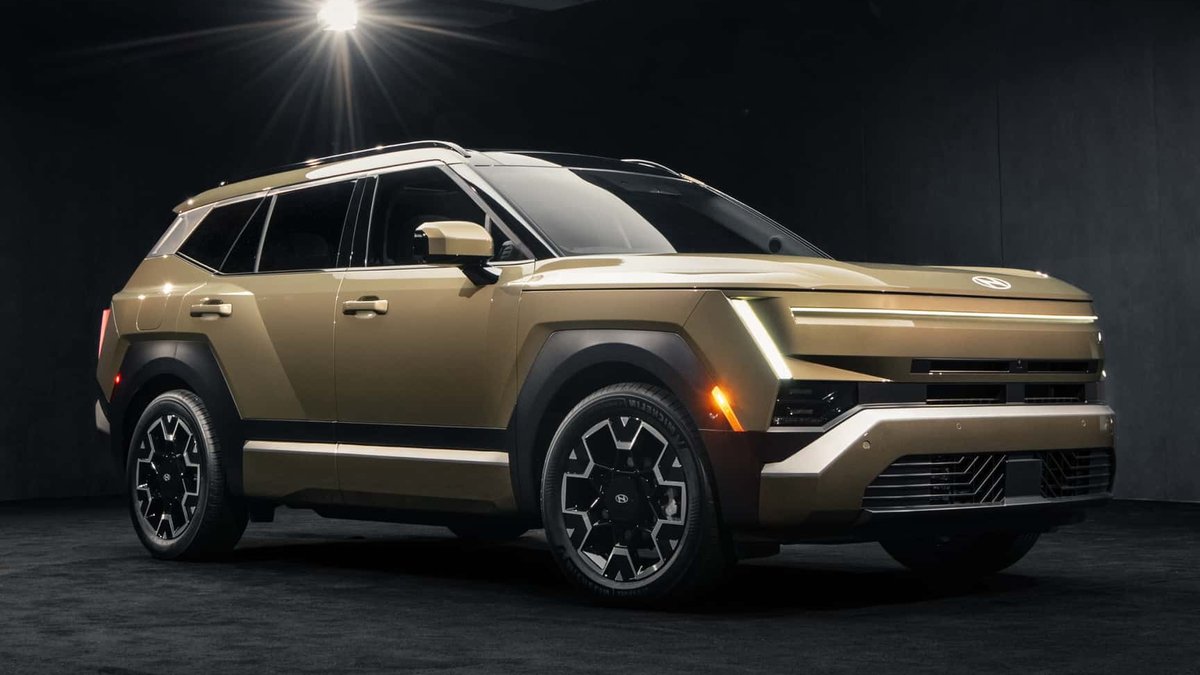
The 2027 Hyundai Tucson debuted in New York last night, marking a significant redesign of the automaker’s best-selling compact crossover. The new model features a more powerful and efficient hybrid-focused powertrain alongside a modern infotainment system designed to compete with latest tech from rivals. The automaker has expanded the Tucson’s size across all dimensions while emphasizing hybridization as a core strategy for its lineup.
Hybrid Powertrain Enhancements
All 2027 Tucson variants are equipped with a 1.6-liter turbocharged four-cylinder engine, available in three configurations: a 184-horsepower gasoline model, a traditional hybrid, and a plug-in hybrid. The hybrid setup introduces a 17-horsepower electric motor integrated directly with the crankshaft, replacing the previous belt-driven starter-generator. This new arrangement allows the motor to assist during acceleration and recharge the battery during deceleration.
The traditional hybrid’s primary electric motor, positioned between the engine and six-speed transmission, produces 64 horsepower and is supported by a 1.49 kWh battery rated at 270 volts. Combined with the gasoline engine, the system delivers 233 horsepower and 279.9 lb-ft of torque, slightly exceeding the outgoing model’s output. Fuel efficiency improves to as much as 42 mpg in front-wheel-drive hybrids with 17-inch wheels, up from 38 mpg previously. All-wheel-drive variants achieve 40 to 42 mpg, compared to 36 mpg in the prior generation.
Plug-In Hybrid and Infotainment Upgrades
The plug-in hybrid variant boosts the main motor’s output to 106 horsepower, increasing total system power to 288 horsepower, a 20-horsepower gain over its predecessor. It replaces the 13.8 kWh unit with a larger traction battery, enabling an estimated all-electric range of approximately 50 miles per charge. However, it has not specified which testing standard applies to this figure, casting some uncertainty on the claim.
Inside, the Tucson features its new Pleos Connect infotainment system, built on Android Automotive OS. Buyers can choose between 12.9- or 17-inch central touchscreens paired with a 9.9-inch digital gauge cluster. The system supports over-the-air updates and includes Gleo AI, a voice assistant capable of handling complex commands. Third-party apps such as Spotify and Waze can be installed directly. Physical controls remain available for key functions, addressing criticism of previous fully digital interfaces.
The 2027 Tucson grows 2.3 inches longer, 1.57 inches wider, and 0.8 inches taller than its predecessor, measuring 185 inches in length, 75 inches in width, and 66.3 inches in height. The wheelbase extends to 109.6 inches, and rear doors now open 83 degrees, up from 73 degrees. Ground clearance ranges from 7.1 inches on standard models to 8.2 inches on the XRT PRO trim. Cargo space increases to 41.7 cubic feet.
The automaker plans to launch gas and hybrid Tucsons in the U.S. in early 2027, with the plug-in hybrid to follow.
Hybrid Technology and Efficiency
The traditional hybrid incorporates an electric water pump across all powertrain variants, enhancing thermal management. A unique Stay Mode allows the climate control, audio system, and other accessories to remain active even when the engine is off. This feature improves cabin comfort during stops without depleting the battery rapidly. The system’s battery maintains compatibility with the outgoing model’s specifications, though its integration with the new crank-mounted motor introduces refined efficiency gains.
Plug-In Hybrid Specifications and Availability
The plug-in hybrid’s traction battery capacity increases to 17.1 kWh, a significant jump from the 13.8 kWh unit in the prior model. It estimates an all-electric range of approximately 50 miles, though no testing standard—NEDC, WLTP, or EPA—is specified, adding uncertainty to the figure.
This restricts refueling speed compared to competitors offering faster DC compatibility. Hyundai has yet to confirm U.S. availability for the plug-in variant, with specifications pending as the automaker assesses market readiness. The gas and hybrid Tucsons are scheduled for early 202