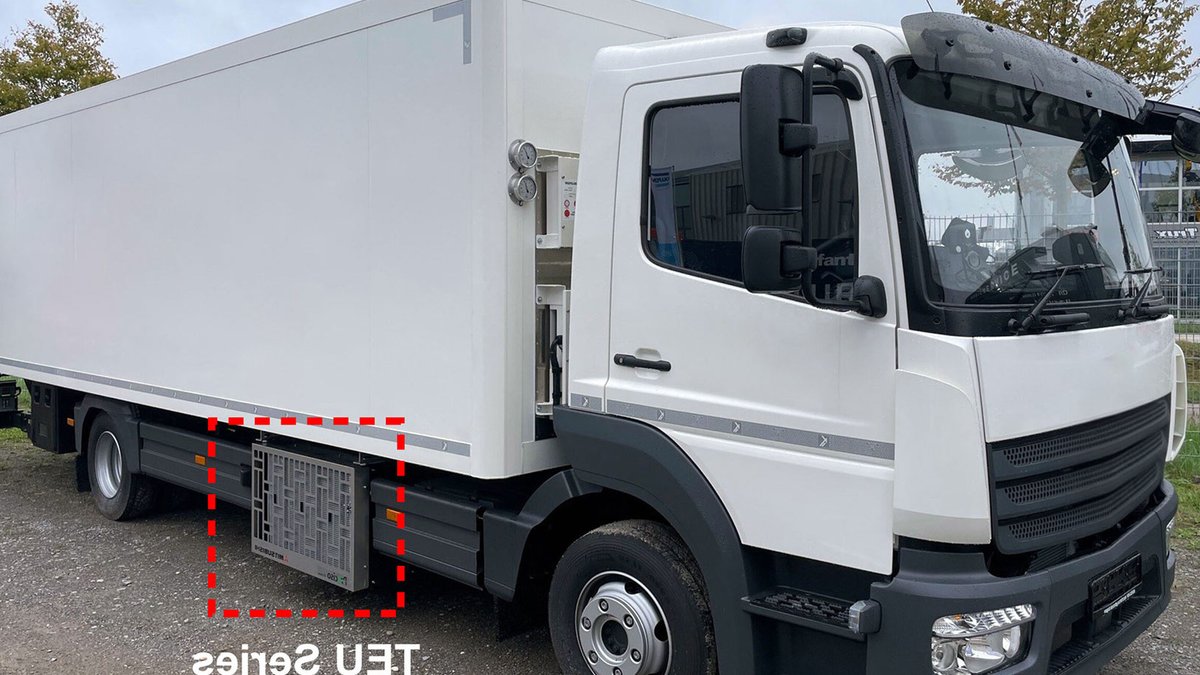
Mitsubishi Heavy Industries Thermal Systems is launching a new range of electrically powered transport refrigeration units in Europe. The TEU series was developed specifically for electric trucks and is designed to take up less space and weight thanks to its modular construction.
Modular Design for Tight Spaces
The Japanese manufacturer has already started selling the new TEU series under its Preciso brand. European sales are being handled by Mitsubishi Heavy Industries Thermal Transport Europe, based in Osnabrück, Germany. The refrigeration units can draw power from an electric truck’s traction battery, but according to the manufacturer, they can also use vehicle-mounted generators or separate batteries dedicated to transport refrigeration.
Limited installation space in electric commercial vehicles was a key consideration during development. MHI Thermal Systems has therefore separated the condenser, evaporator and compressor into individual compact modules that can be arranged differently depending on the vehicle configuration. This is intended to simplify integration when large traction batteries take up part of the available space.
Compared with the conventional TU series with a separate generator, the main unit is said to require around 30 per cent less volume. The required installation opening is 40 per cent smaller, while weight is reduced by 55 per cent. These figures are solely based on information provided by MHI. The manufacturer also cites the lower weight as a potential benefit for the range of electric vehicles, but does not quantify the effect.
Handling Larger Trucks and Multiple Temperatures
Despite its more compact dimensions, MHI says the TEU series is also suitable for large trucks. The manufacturer uses what it calls an economiser circuit for this purpose. Part of the refrigerant is diverted and used to cool the main flow before being injected back into the compressor during compression. This is intended to increase cooling capacity. However, MHI does not state the specific cooling output or how much energy the unit consumes during operation.
With the TEU1400MA, the manufacturer also offers a version with multiple evaporators. Four different evaporator types of varying sizes can be installed in a divided cargo area, allowing goods with different temperature requirements to be transported simultaneously in one vehicle.
Transport refrigeration is a significant auxiliary power consumer for electric commercial vehicles, particularly when it draws energy from the traction battery. MHI is not the only provider looking to electrify transport refrigeration, which has traditionally often been diesel-powered. UK-based Sunswap, for example, uses a separate battery for its Endurance refrigeration units, which can be supplemented by solar modules on the trailer roof. Earlier this year, Sunswap announced its entry into Australia after expanding into several European markets.
MHI, by contrast, offers several power supply options for the TEU series. This is intended to make the system suitable for different vehicle and powertrain concepts. Based on the technical information published by the manufacturer so far, it is not yet possible to assess how efficiently the new transport refrigeration system operates under real-world conditions or what impact it actually has on the range of an electric truck.