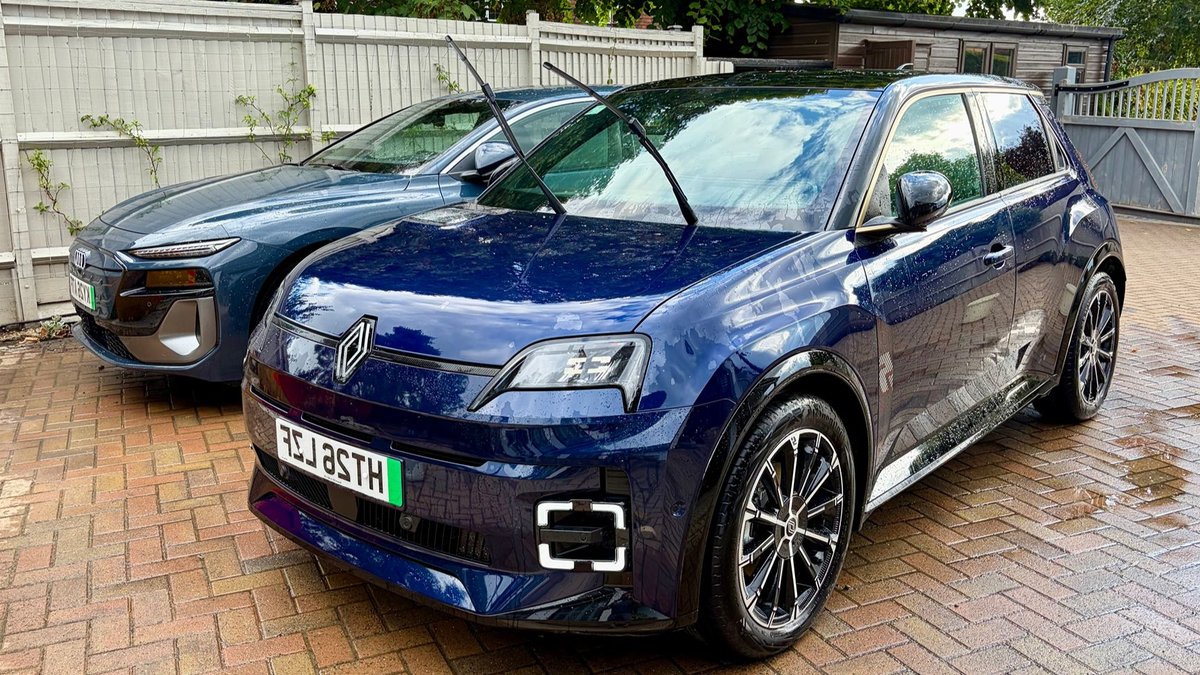
The Renault 5 E-Tech has become an unexpected symbol of electric vehicle community. In the past month, while driving through Surrey’s suburbs, the writer encountered two separate instances of fellow Renault 5 owners waving from opposite directions—an experience that had never occurred before with an electric vehicle. The car’s distinctive styling, especially its bright Pop Green or Pop Yellow paint options, makes it easily recognizable. Even the more restrained Midnight Blue model, like the one tested, stands out when clean, though prolonged heatwaves quickly dull its deep finish.
Renault has recently refreshed the model with both cosmetic and technical improvements. The higher-spec Techno+ and Iconic+ versions now offer gold wheels as an option, paying homage to the 1990s Renault Clio Williams—a tribute to a cherished era of hot hatches. Additional new choices include a star-patterned roof, grey roofline stripes, and Flame Red paint, which enhances the car’s sporty appearance. The Flame Red option mirrors the Rebel Red choice available on the Nissan Micra, which shares the same French production facility.
The mid-cycle update also extends the range of the larger 52kWh battery to 267 miles, up from 252 miles. However, the entry-level Evolution model now uses a 36.5kWh lithium-iron-phosphate battery from the new Twingo, reducing its range to 190 miles and limiting charging speed to 80kW. This change may help lower the starting price to £21,495.
Inside, the Iconic+ model’s previously praised yellow seats will soon be replaced with blue and grey upholstery. A more powerful wireless phone charger has been added, though the Multi-Sense button on the steering wheel has been removed. The car now automatically adjusts between Comfort, Eco, Sport, and Individual modes based on driving behavior, while manual adjustments remain available through the touchscreen.
The Renault 5’s driving experience remains strong after three months
The Renault 5 continues to deliver an engaging blend of agility and comfort even after extended use. The multi-link rear axle, a more responsive but costlier alternative to a torsion beam, provides precise steering and controlled damping. The squared-off steering wheel offers clear feedback, giving the car a lively feel on the road.
Range figures often fall short of official claims. The standard 252-mile range for the 52kWh battery has never been achieved in testing, even under ideal conditions. Real-world performance typically yields 215–220 miles, with an average consumption of 4.4 miles per kWh. Charging at home with Eon Next’s overnight rate of 6.9p per kWh results in costs as low as 1.5p per mile, a figure no petrol or diesel car can match. Public charging stations, however, remain significantly more expensive.
Several minor issues persist. The Hey Reno AI assistant, powered by ChatGPT, occasionally interrupts conversations without prompting. Cheaper plastics on the centre console show early wear, and the car’s compact dimensions, 326 litres of boot space and limited rear legroom, have drawn criticism from taller passengers. For families requiring more space, the Renault 4 SUV serves as a more practical alternative.
The Renault 5’s future takes shape with the Turbo 3E
A prototype of the forthcoming Renault 5 Turbo 3E was recently revealed at Goodwood alongside a long-term test car, highlighting the dramatic differences between the two models. While the standard model retains the classic hatchback proportions of its predecessors, the Turbo 3E is engineered for speed, equipped with a 70kWh battery and two in-wheel motors producing 540hp. This allows it to accelerate from 0 to 62mph in 3.5 seconds and reach a top speed of 165mph.
The Turbo 3E’s design draws inspiration from the original 1980s Renault 5 Turbo, known for its rally heritage and distinctive styling. The new model retains some external similarities, such as the tail lights, wing mirrors, and door handles, but nearly every other detail has been reimagined. Inside, the Turbo 3E adopts a more extreme approach, featuring chunky sills, Perspex side windows, a roll cage, and carbon fibre bucket seats with five-point Sabelt harnesses. The interior also includes retro-inspired digital graphics, a virtual teddy bear named Drifty, and a prominent boost button on the steering wheel.
The Turbo 3E demonstrated its capabilities during a test drive at Goodwood, where it handled with surprising agility despite its power. The in-wheel motors deliver up to 3,540 lb-ft of torque, making it traction-limited off the line. While it lacks the sheer acceleration of some supercars, its balanced handling and playful nature, particularly in corners, set it apart. The model is designed for both track use and road driving, though its limited range of 250 miles may restrict its practicality for daily commutes.
Renault has already received orders for 1,980 units of the Turbo 3E, priced at £135,000 each, with production set to begin next year. Customization options, including multiple liveries and additional features, allow buyers to further personalize their vehicles, with some configurations potentially exceeding £200,000. Meanwhile, the standard Renault 5 remains a more accessible and practical choice for everyday use, offering a balanced combination of performance, efficiency, and compact design.