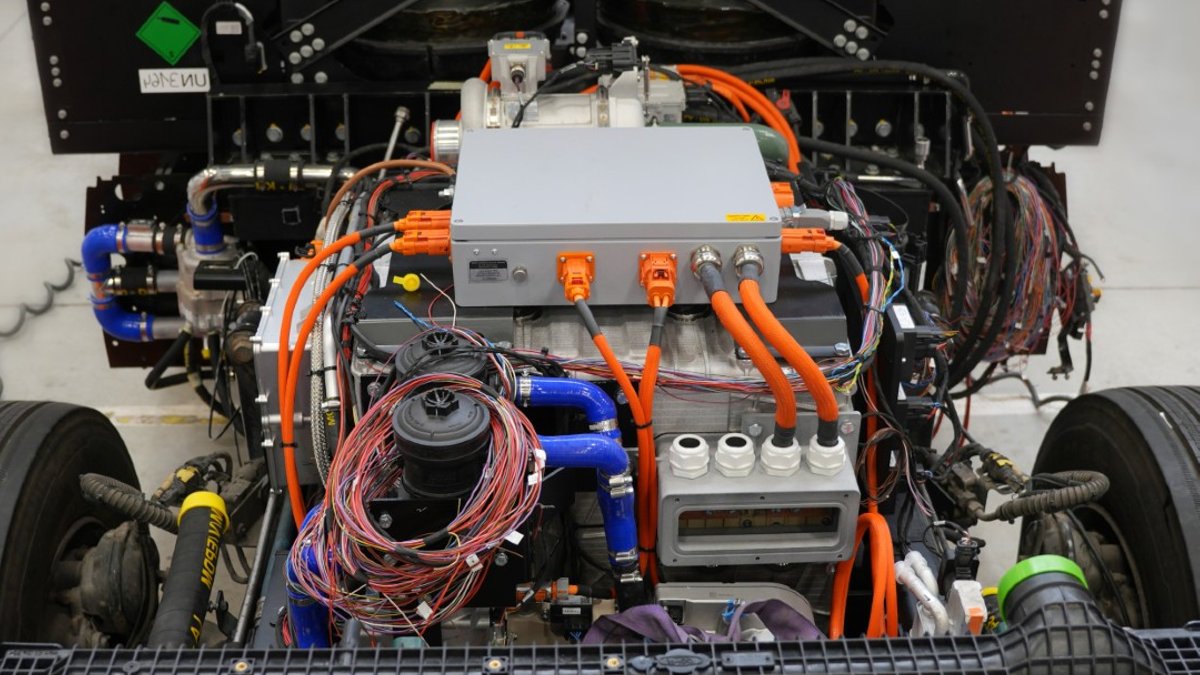
German company EKPO Fuel Cell and Akkodis, a Swiss specialist in digital engineering, will integrate and test a fuel cell stack from EKPO in a hydrogen truck that achieves a system output of up to 360 kW. The partners plan to use the data collected for developing future fuel cell systems that can also be applied to other sectors, such as stationary energy supply, shipping, or off-highway machinery.
The H2 test carrier houses the technology package from EKPO Fuel Cell. EKPO Fuel Cell Technologies and Akkodis have announced plans to test the NM20 fuel cell stack in real-world driving conditions.
Akkodis is responsible for developing and assembling the fuel cell-powered powertrain and integrating it into a 40-tonne hydrogen truck. During its subsequent deployment with a logistics company, the vehicle is expected to deliver critical operational data and demonstrate the technology’s performance under real-world conditions, according to EKPO.
In this project, the truck equipped with the NM20 serves as a mobile development and validation platform. Real-world driving is intended to provide insights into how fuel cell technology performs under varying load profiles, environmental conditions, and operational demands.
For EKPO, the project is a key component of its system engineering approach. The developers state that the fuel cell stack is being deployed and validated at the system level during an early development phase. This allows interactions between the stack, balance of plant, control systems, thermal management, and high-voltage architecture to be identified and optimised at an early stage.
The data obtained will directly feed into the further development of the NM20 and support the transition of the technology into series production. Managing Director, Dr Stefan Dwenger, anticipates that the data gathered from real-world operation will provide valuable insights for further development and make a significant contribution to the industrialisation of hydrogen-powered drivetrains.
Dr Thomas Klukas, CEO of Akkodis Germany, adds: “Integrating a fuel cell into real-world logistics operations is a complex undertaking. It is precisely here that Akkodis excels: they combine technology, system architecture, hardware, and software into a fully functioning system. Working alongside EKPO, they are creating new opportunities to deploy hydrogen technology in heavy-duty transportation and beyond.”
Ekpo Fuel Cell Technologies has developed the NM20 fuel cell stack specifically to meet the demands of heavy-duty applications requiring high power output and efficiency. The NM20 is currently the most powerful fuel cell stack in EKPO’s portfolio and is based on the company’s PEM fuel cell technology.
The new development is rated at up to 400 kW and is designed for a service life of over 25,000 operating hours, making it particularly suitable for cost-effective fuel cell solutions in long-haul transport. A one-stack-one-system approach is being applied in the demonstration vehicle.
This means the hydrogen truck operates with just one NM20 fuel cell stack, achieving a system output of up to 360 kW with efficiencies of up to 61%, according to the partners. The concept demonstrates that high-performance fuel cell systems can be developed even without complex multistack architectures.
As the project progresses, the insights gained from this integration will have a significant impact on the development of future fuel cell systems, potentially leading to more efficient and cost-effective solutions for various industries. The data collected will be used to create a reference platform for system integrators and vehicle manufacturers, supporting the design, integration, and validation of their own applications.
The findings are not limited to road freight transport but can also be applied to other sectors, such as stationary energy supply, shipping, or off-highway machinery. The development and commercialisation of the NM20 stack are supported under the European funding programme IPCEI.
Ekpo operates across a broad range of applications, positioning itself as a full-service provider of fuel cell stacks and components for use in passenger cars, light commercial vehicles, trucks, buses, as well as rail and marine applications. Ekpo is a joint venture between the automotive suppliers ElringKlinger and OPmobility, and it has collaborations with companies like Toyota in the field of air taxis.
Ekpo’s technology has the potential to be used in various industries, including the automotive sector, where companies like Mitsubishi are working on new technologies.