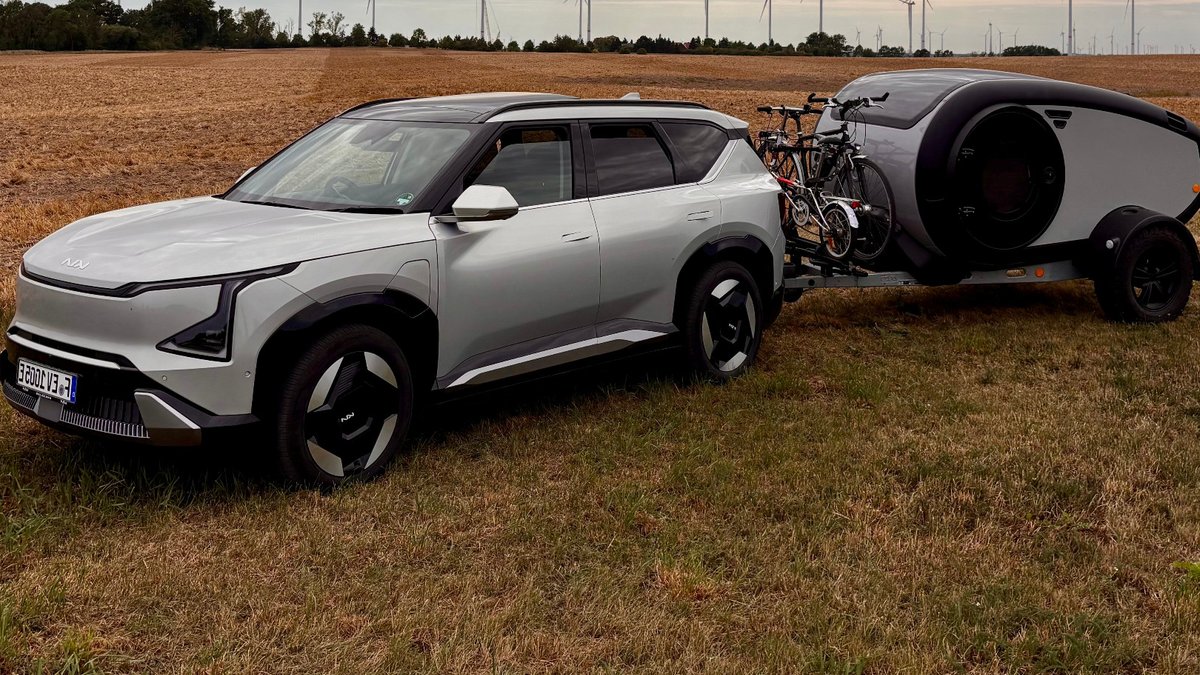
For the front-wheel-drive Kia EV5 Earth with 19-inch wheels, the manufacturer states a WLTP range of 520 kilometres and a consumption of 17.1 kWh/100 km. My summer test vehicle in Ivory Silver Metallic, including optional equipment, costs €54,250. Need to boil a kettle, charge a laptop, or use a hairdryer – with no power socket in sight? Not a problem. There’s plenty of electricity onboard. During a stay at a small campsite near the Polish Baltic coast, it became clear that one feature of the Kia EV5 proved to be one of its greatest strengths on this trip – a feature that would typically merit only a few lines in a standard road test: vehicle-to-load.
A Rolling Power Bank
At a campsite near the Baltic coast, the Kia EV5 served as a generator for everyday needs. With no grid connection available, the driver connected an extension lead to the car and plugged in the V2L adapter. This setup allowed the use of a kettle, hairdryer, and laptop charger without draining the main battery. The electric hotplate, a planned future addition, could eventually eliminate the need for a gas stove entirely. For a small teardrop caravan like the Mink Camper 2.0, the car provides a generous supply of electricity for life on the road.
Related: BMW readies Leipzig plant for Neue Klasse
It is worth noting that the practical benefits of V2L extend beyond the technical specifications. While the spec sheet lists charging an e-bike or powering tools, the real-world application for campers is the ability to forgo a traditional grid hookup entirely. This shifts the focus from consumption to utility, turning the vehicle into a versatile energy hub.
Towing the Mink Camper
The front-wheel-drive EV5 is approved to tow braked trailers up to 1,200 kilograms, making it suitable for the Mink Camper 2.0, which has a tare weight of 490 kilograms and a maximum permissible weight of 750 kilograms. The electric drive offers a smooth, quiet experience without gear shifts or revving. The compact camper remains stable behind the Kia and sits neatly in its slipstream, even on rougher tracks.
On a 404-kilometre journey through Poland, the average consumption with the caravan attached was 24.4 kWh/100 km. This figure is remarkably low, especially when compared to the Kia’s stated WLTP motorway consumption of 23.3 kWh/100 km. The range calculation suggests that a realistic driving stage of 250 to 300 kilometres is achievable before needing to recharge, which aligns well with typical rest stop intervals.
Related: Hydrogen truck gets new fuel cell stack
Practicalities of the Journey
Software features also played a role in the trip. Once the trailer is connected, the EV5 switches to trailer mode, adjusting the range prediction to account for increased consumption. This feature helps mitigate range anxiety for the driver. The charging port is located at the front right, behind the front wheel. This placement is useful for charging at supermarkets or parking lots, as the car can drive forward to the charging point and reverse out without unhitching the trailer, provided there is sufficient space.
The trip highlighted that charging infrastructure reliability is often more critical than the car’s charging speed. On this route, fast chargers were under maintenance or incompatible with payment methods. The driver ultimately relied on a roaming German charging card to access older stations.
Driving Experience and Interior
The EV5’s interior offers five fully usable seats and a boot capacity of 566 litres, which increases to 1,650 litres with the rear seats folded. The double loading floor takes up some height but keeps the floor level for loading small items and cables. The cabin features a mix of digital and analogue elements, with a central 12.3-inch display and physical buttons for essential functions.
Related: What Genuinely Helps When Passing Your HGV Practical Test
Driver assistance systems provided a mixed experience. The attention warning system occasionally prompted a break shortly after setting off, and the lane-keeping assist often prioritized the right-hand markings on narrow Polish roads, making it feel intrusive. However, on the motorway, the EV5 drove calmly and quietly. The driving modes—Eco, Normal, and Sport—slightly alter the character, though the “Sport” setting does not provide the expected performance.
The EV5 is designed as a travel car that prefers to glide rather than carve through corners. This relaxed driving character, combined with its towing capacity and V2L feature, makes it a practical option for camping trips. The 81.4-kWh battery serves not just as energy for driving but as a power source for life beside the car, redefining the electric camping experience.