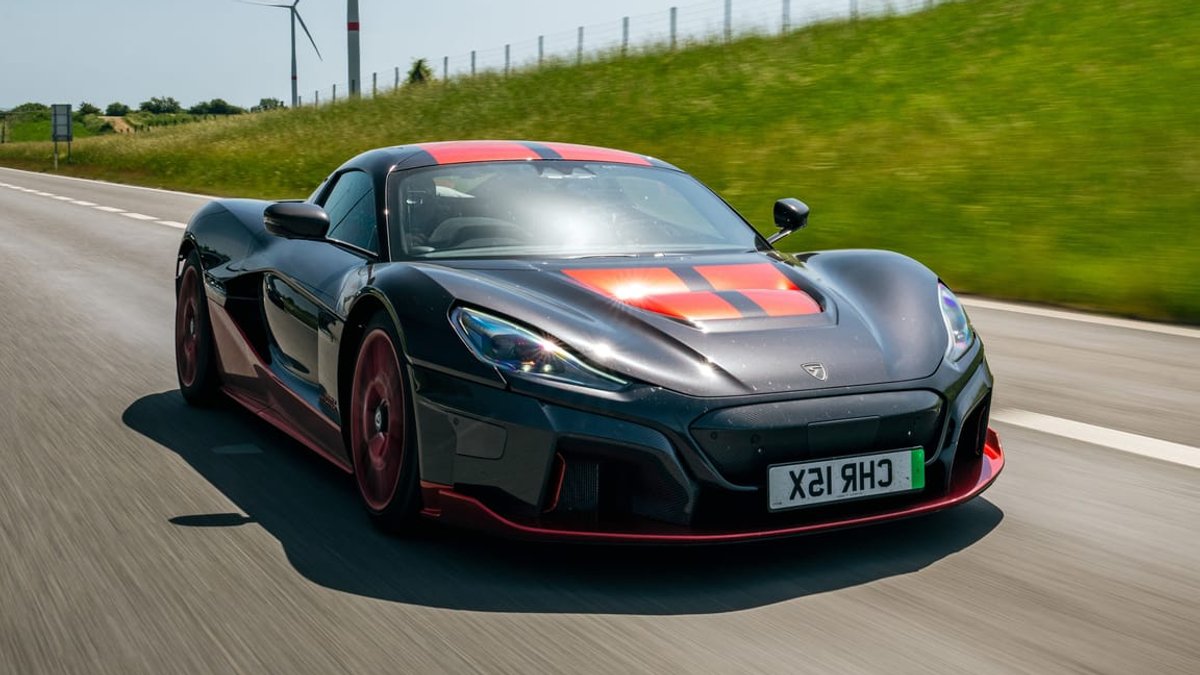
The Rimac Nevera is a vehicle designed for high speed, yet Chris Brown used it to travel to some of the most inaccessible places on Earth. Last year, the Croatian electric hypercar manufacturer invited owners to its headquarters in Zagreb, but Brown expanded the challenge. Instead of driving directly to the destination, he mapped a 1,391-mile route from his home near Harrogate in England to Croatia, including stops at remote locations few people ever visit.
Chasing the World’s Most Remote Spots
Brown’s expedition focused on reaching “points of inaccessibility”—the farthest locations from borders, coastlines, or cities. Along the way, he visited Britain’s inland center, a spot 70 miles from any ocean, and similar landmarks in Belgium and Luxembourg. The route was planned using ChatGPT, showing the trip was not limited to hypercar enthusiasts.
After studying physics and working in the oil industry, he transitioned to technology entrepreneurship. His garage still holds a Range Rover, an Aston Martin V12 Vantage, and a Lamborghini Revuelto, but the Nevera stands out. “The Rimac has ruined my experience of the Revuelto because it’s faster and more comfortable,” he says.
His journey extended beyond the car itself. Brown has already visited seven of the eight official “poles of inaccessibility”—the farthest points from oceans on every continent. The last, in Eurasia, lies in northwestern China, where travel restrictions and a lack of charging infrastructure make access nearly impossible. “China is streets ahead of us in terms of automation, robotics, AI. It’s clean, it’s safe and everything, but the cost is the population is controlled. So even for a Chinese person to get to where I want to go, it’s not allowed.”
Leisurely Hypercar Road Trip
The Nevera’s 1,888 horsepower could have made the trip a blur of acceleration, but Brown treated it as a leisurely road adventure. He took detours to the Dalmatian Coast, exploring regions most tourists overlook. “You could drive to it, you could cycle or hike to it I suppose, but by driving you see stuff and meet people that you just wouldn’t normally see when you’re visiting a country.”
Read Also: Tata Punch EV Facelift Focuses on Practicality, Range
For Brown, the trip held deep personal significance. His father’s influence, watching Apollo missions together, shaped his path. Later, he joined the Virgin Galactic program, which led to a visit to the South Pole with Buzz Aldrin. “Landing at the South Pole with him was when I heard about poles of inaccessibility. When I was up Everest two years later, I was thinking ‘I don’t really enjoy mountaineering’, so why don’t I try to reach all these poles instead?’”
The Nevera’s range and Rimac’s charging network made remote exploration feasible. Brown emphasized reliability over speed, proving that even the most isolated spots were accessible. “You can’t just go hiring helicopters willy-nilly.”
Visiting Point Nemo Before Space Debris Arrival
Brown’s visit to Point Nemo, the Pacific’s most isolated location, held broader significance. NASA and SpaceX had already designated the coordinates as the target for the controlled deorbit of the International Space Station in 2031. Most of the station’s 420-ton structure will burn up during re-entry, but around 40 tons of debris, including solar panels and laboratory modules, are expected to survive. Point Nemo’s remoteness ensures any fragments will land in the ocean’s least trafficked area, far from shipping routes or human settlements. Brown, who swam there in 2022, became the first person to visit the site before its future role as Earth’s space debris disposal site.
The Nevera’s electric range and Rimac’s expanding charger network were essential. Brown planned the route around charging stops, ensuring the hypercar could complete the 1,391-mile trip without unnecessary detours. Unlike traditional road trips, where fuel stations dictate stops, the Nevera’s efficiency allowed flexibility, stopping only when necessary, not when required. The car’s quiet cabin also made interactions with strangers along the way more natural.