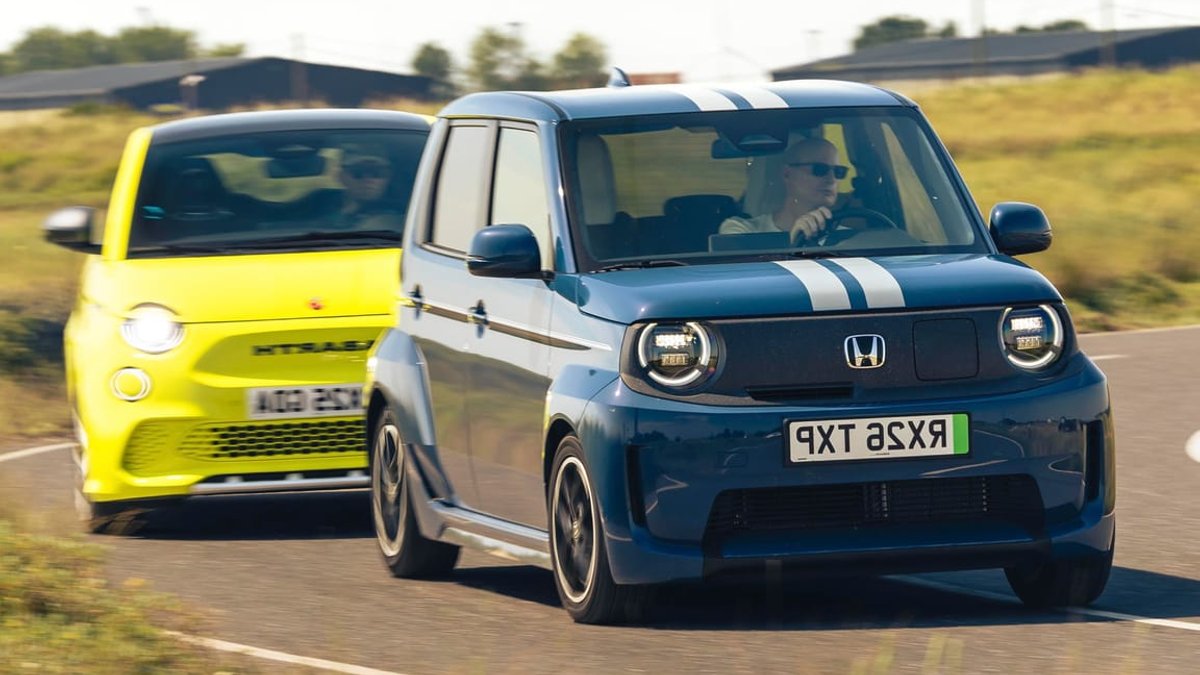
A small electric car with a simulated engine sound may seem like a novelty, but it serves a practical role. Engine noise in an EV provides feedback on speed, power delivery, and cornering grip without requiring constant checks of the speedometer. This is why the Honda Super-N and the Abarth 500e, two electric hot hatches featuring artificial audio cues, warrant closer examination.
The two cars are not direct competitors. The Abarth 500e produces nearly double the power of the Super-N and carries a higher price tag—though the £3,750 UK government incentive reduces its cost to £27,245. Both models share a key trait: they replicate internal combustion engine sounds, and they do so for reasons beyond marketing.
The Honda Super-N’s Simulated Gearbox
The Super-N’s approach to sound simulation is more advanced. It doesn’t simply replay a generic engine note—it emulates seven virtual gears. Higher gear ratios reduce acceleration and regenerative braking but allow for greater top speeds, while lower ratios deliver more immediate power and braking effect but limit maximum velocity. A digital rev counter fluctuates with the pitch, and hitting the simulated redline triggers a speed limiter. None of this is physically real—it’s all software—but the feedback feels intentional.
The sound itself is a rough, unturboed growl, reminiscent of older Japanese kei cars. It lacks the lag of a forced-induction engine, making it more immediate. The Abarth, by contrast, uses a single fixed audio cue that covers the entire speed range. This can make the car feel as though it’s stuck in one gear, even as it accelerates smoothly.
The Super-N’s styling divides opinions. It follows Honda’s kei-car regulations, which restrict size and power in exchange for tax benefits, rules that don’t apply in the UK. The result is a boxy shape that’s surprisingly spacious inside, with thin but wide-opening doors and Honda’s Magic Seats in the rear. The boot is tiny, but the cabin accommodates four passengers comfortably. The Abarth, based on the Fiat 500, prioritizes style over practicality. Rear passengers endure reduced legroom, headroom, and visibility, but the front seats are well-supported, and the Alcantara-trimmed dashboard adds a premium touch.
The Super-N’s driving experience is misleading. In normal mode, its 64 horsepower feels unremarkable, until the purple button on the steering wheel is pressed. Boost mode unlocks 94 horsepower, activates the fake gears, and turns the instrument cluster purple. The change is immediate: acceleration improves, and the sound cues make the car feel more engaged. Testers primarily used auto mode, relying on paddles for regeneration and occasional manual shifts.
The Abarth’s noise is intentionally aggressive. Fans selected the tone through voting, and it mimics a four-cylinder petrol engine with a sporty exhaust note. The generator is mounted under the boot, making the sound audible outside the car. It reaches the legal decibel limit for petrol vehicles and revs sharply when accelerating from a standstill. In urban areas, this is intrusive, but on open roads, it adds to the driving experience.
Performance and Practicality
The Abarth 500e outperforms the Super-N in acceleration. Its 0–62 mph time of 7.0 seconds beats the Honda’s 10.0 seconds, despite the Super-N’s lighter weight of 1,097 kg. The Abarth’s motor and electronics are tuned versions of the standard Fiat 500’s, allowing for higher power output. The Super-N’s small 28 kWh battery limits its range to 128 miles, while the Abarth’s 37.3 kWh pack delivers 157 miles. Real-world testing showed an even wider gap: the Honda managed just 100 miles, while the Abarth reached 145.
Charging times reflect these differences. The Super-N’s 50 kW peak charge rate performs poorly in heat, taking 50 minutes to reach 20–80% state of charge, enough for only 60 miles of driving. The Abarth, on the same charger, covers more distance in the same time.
The Super-N’s lightweight design makes it agile in tight spaces. It corners with a playful, flickering motion, though road noise and a confined cabin remind drivers of its budget nature. The Abarth, despite its higher seating position, feels more composed. Its steering is lighter, the brakes have longer travel, but the car remains responsive. The ride stiffens at lower speeds but smooths out on country roads, offering better control.
The artificial engine noise in the Abarth aids cornering cues, though it lacks regeneration paddles. A drive mode switch adjusts braking intensity, mimicking a downshift when lifting off the throttle.
The Super-N’s appeal lies in its quirks. It functions as a city scooter with surprising space and a playful attitude, but its limitations, range, charging speed, and lack of sophistication, make it better suited as a secondary vehicle. The Abarth, while less practical for rear passengers, is the more capable long-distance option. Its noise can be switched off, which helps in urban areas but adds to the fun on open roads.
Design Honesty and Driver Feedback
The artificial engine sounds in both models serve a functional purpose beyond evoking nostalgia. In electric vehicles, where traditional auditory cues are absent, these simulated noises provide essential feedback for drivers, particularly when maneuvering corners or adjusting speed without looking at the dashboard. The Super-N’s seven simulated gears, for instance, create a more detailed relationship between acceleration and speed. Higher ratios reduce power but allow greater top-end velocity, while lower ratios deliver more immediate response but cap maximum speed. The system includes a digital rev counter that rises and falls with the pitch, reinforcing the illusion of mechanical engagement.
Engine Sound Design and Driver Feedback Mechanics
The Honda Super-N’s simulated engine noise is tied to a software-driven gearshift system that alters how power is delivered. When shifted into higher virtual gears, the car’s acceleration softens while regenerative braking increases, but top speed potential rises. Lower gears provide stronger acceleration and more pronounced regenerative braking, though they cap maximum velocity.
Engineering Trade-Offs and Practical Constraints
The Honda Super-N’s design follows Japanese kei-car regulations, even in markets where those rules don’t apply. The boot, however, remains impractically small, reinforcing the Super-N’s role as a city-focused vehicle rather than a long-distance companion. Inside, the cabin feels well-appointed for its price, with physical climate and lighting controls, though the lack of adaptive cruise control and limited range make it less suitable for solo drivers relying on it as their primary car.